
Full-Depth Reclamation Lowers Costs and Environmental Impact
In today’s roadway repair environment, the practice of removing the old roadway material and replacing it with new is often impractical from the standpoint of cost and environmental impact. An increasingly useful alternative is known as Full-Depth Reclamation (FDR). FDR is a roadway reconstruction method that involves recycling the existing asphalt pavement structure and using it as the base for the new roadway. The team at Snyder & Associates has increasingly made use of this cost-effective and sustainable alternative to traditional roadway reconstruction. Before explaining the FDR process, however, it’s critical to discuss the benefits of FDR and when it’s most appropriate to use this method over full removal and replacement.
Benefits of Full-Depth Reclamation Roadway Repair
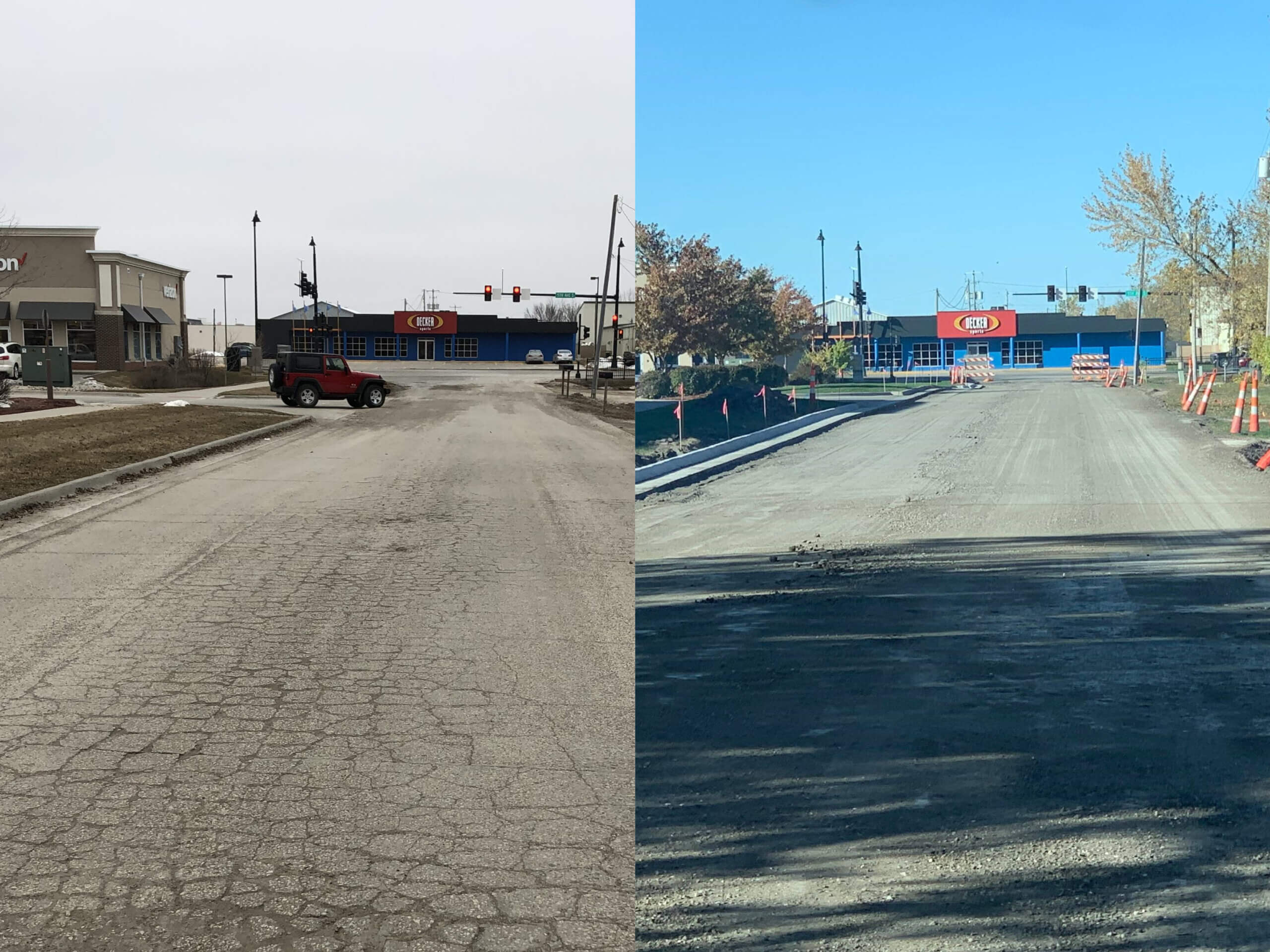
Alligator cracks had seriously compromised this section of the roadway (left). The FDR process, however, reuses this surface layer as the new base (right).
There are several reasons why FDR is a preferred method of roadway reconstruction over traditional methods. First, FDR is more cost-effective. Because it involves recycling the existing pavement material, there’s no need to purchase and transport new materials, which substantially reduces the cost of the project. In addition, FDR is typically a faster process, as it does not require the complete removal and replacement of the old pavement. This can save time and reduce disruptions to traffic flow during construction.
Second, FDR is more environmentally friendly. Recycling the existing pavement reduces the amount of waste generated and the need for new materials, which can reduce the project’s carbon footprint. Also, FDR often involves the use of additives, such as asphalt emulsion or cement, which can improve the stability and durability of the recycled pavement material. This can reduce the need for maintenance and repair over the lifespan of the roadway.
Third, FDR can improve the overall quality of the roadway. Simply by recycling the existing pavement material, FDR generally creates a stronger and more stable base for the new roadway. Additionally, FDR eliminates ruts, rough areas, and potholes, as well as alligator, transverse, longitudinal, and reflection cracking. In addition, FDR restores the grade contours to allow for better surface drainage. This further increases the lifespan of the roadway and reduces future maintenance costs.
When to Use Full-Depth Reclamation over Complete Roadway Replacement
FDR is most appropriate for asphalt roadways that have reached the end of their useful lifespan and have deteriorated due to age, heavy traffic, or environmental factors such as temperature changes and moisture. However, FDR is unsuitable for concrete pavements, as the recycling process can weaken the concrete, leaving it unsuitable for use as the new base. FDR is also a good option for roadways that need significant repairs, improvements, or substantial redesign. For example, FDR can add layers to a roadway to increase its thickness and strength or add features such as curbs and gutters. FDR can also be used to correct issues with the existing roadway, such as unevenness or drainage problems.
Steps Involved in the Full-Depth Reclamation Process
- The first step in the FDR process involves milling. Milling removes the top layer of the existing pavement using a specialized piece of equipment and grinds the material into a pulverized mix. This step is necessary to create a smooth and even surface for the new roadway. The depth of the milling will depend on the condition of the existing pavement and the desired thickness of the new roadway.
- Once the top layer of the pavement has been removed, the next step is to mix the pulverized pavement material with additives such as asphalt emulsion or cement. This process can also include adding chemicals to the base layer to increase its strength capacity. The treatment of the base layer and recycled asphalt provides a stronger foundation for current and future traffic loads and effectively produces a cost-effective solution that maximizes limited budgets.
- After the pavement has been mixed, it’s compacted using heavy machinery to create a stable and even base for the new roadway.
- The final step is to shape the recycled pavement material to match the desired profile of the new roadway. This may involve adding additional layers of material to increase the thickness of the roadway or adding features such as curbs and gutters.
Full-depth reclamation is a cost-effective and sustainable alternative to traditional roadway reconstruction. It takes cold, in-place recycling to the next level by grinding up the old pavement and using it as a stronger foundation for the new roadway. As this process continues to gain widespread use, our team will continue to recommend its use whenever possible, as a cost-saving measure for our client communities.