Designing for Trail-User Safety
The explosion of multi-use trails nationwide has been a boon to recreational trail users, community residents, and businesses. Trails provide a non-motorized means of traveling through and around a community while creating new revenue streams for businesses surrounding the trail alignment. With these benefits, however, comes the potential for conflicts between trail users and vehicle traffic, most commonly near at-grade crossings. Because of this prospect, designing trail crossings with safety in mind is one of the most critical components of trail planning.
4 At-Grade Roadway Surface Crossing Treatments and Safety Measures
One of the advantages of using a trail is that it provides a dedicated right-of-way to pedestrians and bicyclists that minimizes interactions with vehicles. An important consideration when designing a trail crossing is that many trail users, especially cyclists trying to maintain momentum, may have a low tolerance for long delays at crossings. While several common types of roadway trail crossings are covered in the Guide for the Development of Bicycle Facilities produced by the American Association of State Highway and Transportation Officials (AASHTO), there are other types that designers need to treat on a case-by-case basis.
Skewed Trail Approach
In a perfect world, all trails would meet the roadway at 90°, ensuring high visibility and clean sight lines for users and vehicle traffic. However, many routes (especially those following former rail lines) approach the roadway at an acute angle, creating a less-than-ideal safety situation. To improve these crossings, designers often create a reverse curve or “S” alignment in the trail to bring the junction closer to perpendicular to the roadway. Designing a reverse curve into the trail alignment can also act as a visual cue or “traffic calming” measure to slow bicyclists as they approach the crossing.
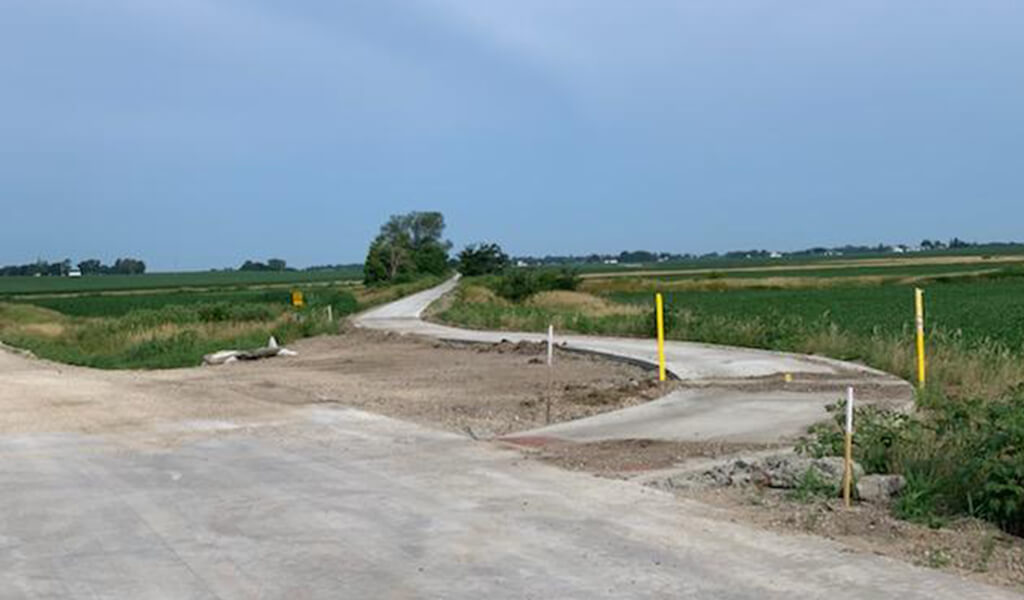
A skewed alignment brings the trail closer to the perpendicular near the crossing.
Trail Signage & Striping
While trail users are responsible for slowing or stopping at roadway crossings, it’s also important to make drivers aware of trail crossings. These overlapping goals can be accomplished using a prominent tool: signage. Signage is not the only way to create safer crossings, but it is often the most direct. It’s best to keep in mind, however, that the Manual on Uniform Traffic Control Devices (MUTCD) states, “the use of warning signs should be kept to a minimum, as the unnecessary use of warning signs tends to breed disrespect for all signs,” making it more likely they’ll be ignored entirely. To supplement signage, pavement markings on both the road and the trail are methods to improve driver and trail user recognition of crossings. Multiple crosswalk marking types are acceptable depending on jurisdictional preference and the volume of vehicles and trail users. With a higher volume of roadway or trail users, consideration should be made to implement high-visibility signage or pavement markings to raise driver awareness of the crosswalk location. Other crossing control options may be considered on a case-by-case basis. FHWA’s Guide for Improvement Pedestrian Safety at Uncontrolled Crossing Locations is an excellent resource to reference.
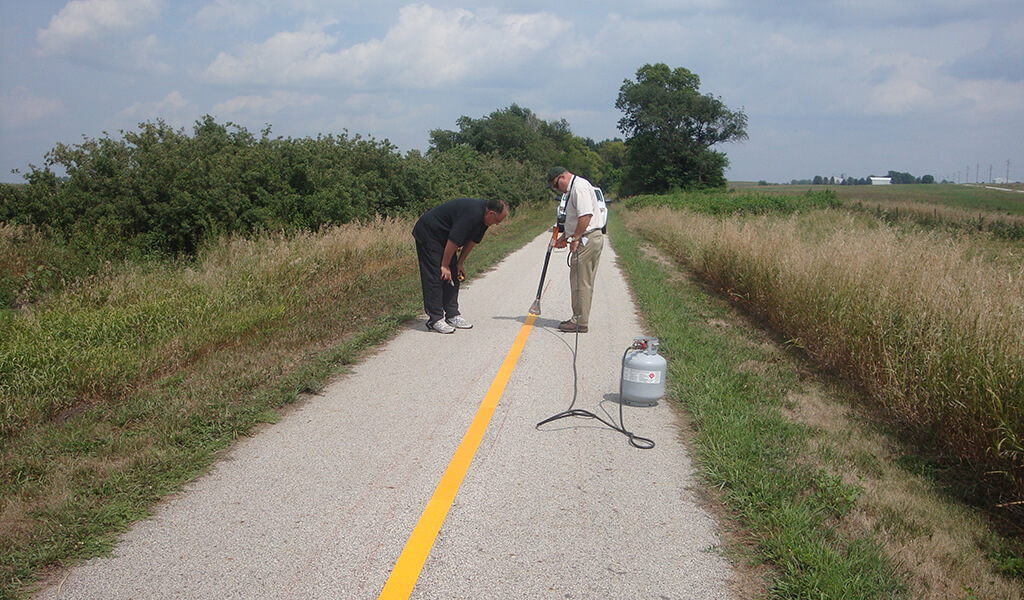
Striping can separate trail travel lanes, much like on the roadway.
Raised Crossings & Speed Tables in Low-Speed Areas
In urban low-speed environments, using a raised crosswalk or speed table provides a visual cue to vehicles on the possibility of pedestrian/bike crossings. It requires vehicles to lower speed to traverse the raised crosswalk. Proper roadway signage and pavement markings accompany this element to alert drivers. Raised crosswalks can also be constructed of a contrasting color to the adjacent pavement, providing added visibility. This can include concrete pavers or colored concrete. Design considerations need to be made on the geometry of the raised crosswalk so that vehicles can traverse it at an acceptable low speed without damaging the bottom of the vehicle. Also, special consideration is typically needed to maintain positive roadway drainage across the raised crosswalk.
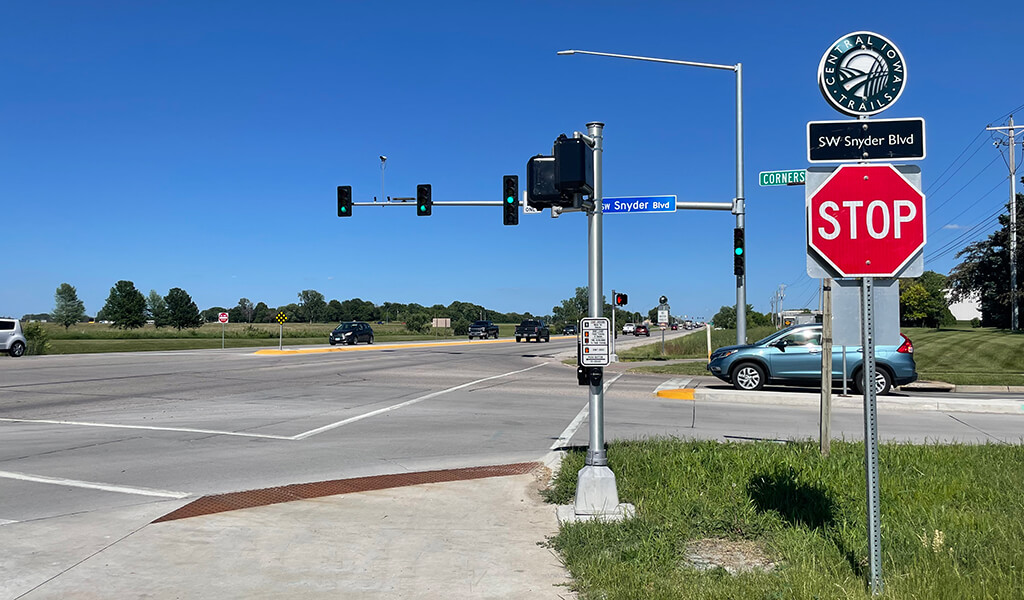
Truncated dome mats and audible crossing warnings help the sight and hearing impaired navigate the crossing.
ADA Compliance at Crossings
To comply with ADA requirements, detectable warning systems must be installed at all crossings to increase accessibility and safety. This is typically accomplished using truncated dome panels. Embedded in the concrete, trail users can see, feel, or hear these panels, indicating a crossing is directly in front of them. While these devices may be viewed as a minor nuisance to inline skaters and skateboarders, they are necessary to ensure the safety of all users. It’s also common for rural paved trail sections to cross a gravel road. To keep trail users from crossing loose gravel, a concrete area is constructed on either side of the crossing, allowing pedestrians and bicyclists to stay on a paved surface. Keeping at-grade crossings to a minimum is always ideal when designing multi-use trail alignments. However, their necessity shouldn’t prevent (or even slow) the rapid development of these critical infrastructure pieces as we seek a healthier and more sustainable world. While not all-inclusive, employing several features will provide an improved and safer interaction between vehicle traffic and trail users for at-grade crossings.