
Celebrating National Bike Month
May 1st marks the beginning of National Bike Month for 2025. Throughout the country, communities, transportation professionals, and cycling enthusiasts are recognizing this month-long celebration of all things bicycling. Established in 1956 and promoted by the League of American Bicyclists (also known as the Bike League, or simply the League), National Bike Month is a chance to showcase the many benefits of bicycling — and encourage more folks to leave their car at home and give biking a try.
This year’s National Bike Month celebration will focus more on riding “there,” whether “there” is to the grocery store for essentials or simply to a local park with the kids. Part of making progress on the League’s vision is encouraging everyone to move towards a holistic approach by integrating bicycling into as many aspects of our daily lives as possible.
Also happening again in 2025 is the popular Bike to Work Week (May 12-18) and Bike to Work Day (Friday, May 16). The League hopes that promoting these popular events will inspire more commuters to make the switch to biking. To add even more flavor to the month, the Love to Ride organization has once again teamed up with the League to promote their National Bike Challenge. This fun, friendly competition urges individuals, businesses, and communities to compete to see which can get the most friends, family, and co-workers to ride a bike during May.
For the planners at Snyder & Associates, the numerous events surrounding National Bike Month is terrific news. “As transportation professionals, we recognize National Bike Month as an opportunity to not only celebrate a beloved pastime but also engage more members of our community in the fun-filled, active, and rewarding experience bicycling creates,” shares Rich Voelker, P.E. for Snyder & Associates.
He goes on to note that bicycling provides multiple benefits on both individual and community-wide levels. As a means of transportation, biking helps us mitigate our impact on the environment and gets us out of our cars. This simple step allows us to better interact with community spaces including parks and trails. On an individual level, it leads to improved health — both physically and mentally, engages us with nature, saves money, and provides active alternatives for commuting. Whether you’re riding for fun or fitness, or taking essential trips to work or shop, you’re a part of the intertwined movement for safer streets, connected communities, a healthier planet, and happier people.
Industry-Leading Advocates for a Safer Bicycling Environment
Multi-Use Trail Planning
The Snyder & Associates trail design practice began in the early 1990s and has grown exponentially since then — along with our team’s expertise. In those almost three decades, we’ve helped plan and design almost 400 miles of paved and granular trails. As the Midwest’s industry leader in the development of multi-use trails, our planners are intensively committed to advancing the safety and efficiency of active transportation networks.
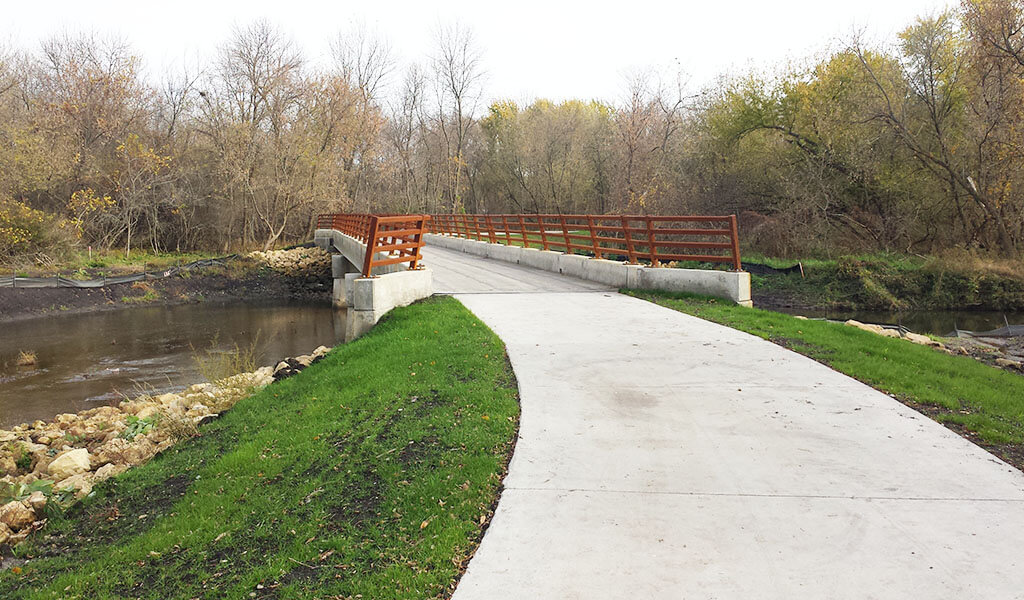
The recently created trail network and bridge enhance the recreational offerings in Troy Park in the community of Robins.
Multi-use trails provide safe, efficient routes for non-motorized travel and have been shown to increase property value, encourage economic development, and promote active lifestyles. They serve as a vital link between neighborhoods, schools, businesses, parks, and other community amenities. In both small towns and big cities, trails are the backbone of active transportation and recreation networks that improve the quality of life locally, as well as regionally.
Our trail planning and development team has also created numerous designs following the popular rails-to-trails concept. These multi-purpose public paths follow former railroad rights-of-way, taking advantage of the often flat, existing corridors that typically follow a gentle grade through urban, suburban, and rural areas. Many regional trail networks that are popular with the bicycling community were created following the rails-to-trails concept.
Similar to the rails-to-trails concept, greenways are corridors of protected open space managed for recreation and conservation purposes. Greenways often follow natural land or water features and link nature reserves, parks, cultural features, and historic sites with each other and with populated areas. Because of these attractive characteristics, greenways are often considered for trail construction to provide better biking and walking access.
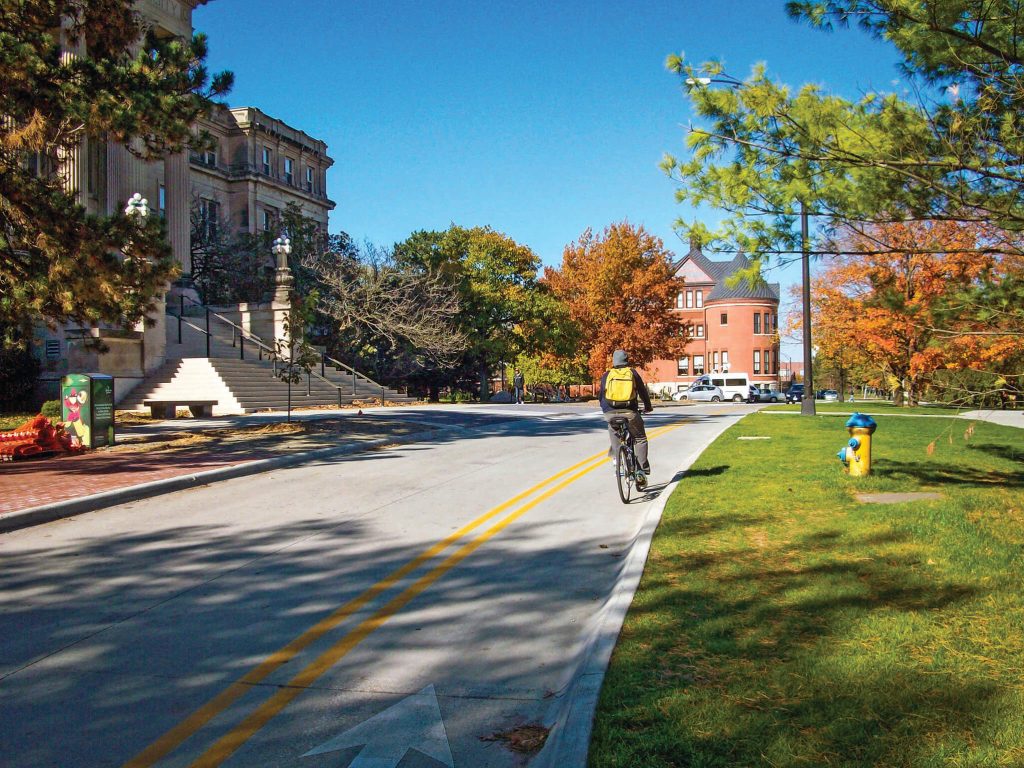
The contra-flow bike lanes on the campus of Iowa State University in Ames are just one example of how we integrate multimodal facilities into an existing roadway network.
Multimodal Planning
The Snyder & Associates planning team also champions safer biking and pedestrian access through the design of multimodal transportation networks. However, multimodal transportation planning and design are about more than simply providing safe and efficient bicycle and pedestrian infrastructure for all ages and abilities. They’re also about creating an attractive character and sense of place for neighborhoods and communities through pedestrian-oriented streetscapes. From promoting health and fitness to reducing traffic congestion and environmental impact, multimodal transportation is vital to community well-being and sustainability.
Our multimodal designs strongly focus on “Complete Streets” concepts, ADA compliance, and user comfort. We create active transportation networks that encourage and support equitable mobility through the use of spacious sidewalks, separated bike lanes, and attractive streetscape amenities. These features can be integrated within a motorized transportation network to create an easily navigable network for people biking, walking, or using transit. Our experts are well-versed in analyzing existing and future land use and traffic operations, identifying areas for improvement, and creating strategic solutions for any size community.
Advisory Bike Lanes
Advisory bike lanes, also known as advisory shoulders or dashed bicycle lanes, are an emerging bicycle facility our team uses to further promote bicycling in the communities we serve. These lanes are comprised of broken or dashed lane lines along both sides of paved roadways that accommodate people biking and sometimes walking. Currently, advisory bike lanes are not part of the Manual on Uniform Traffic Control Devices (MUTCD) published by the Federal Highway Administration (FHWA). To implement an advisory bike lane, a jurisdiction must apply for “experimental status” through the FHWA.
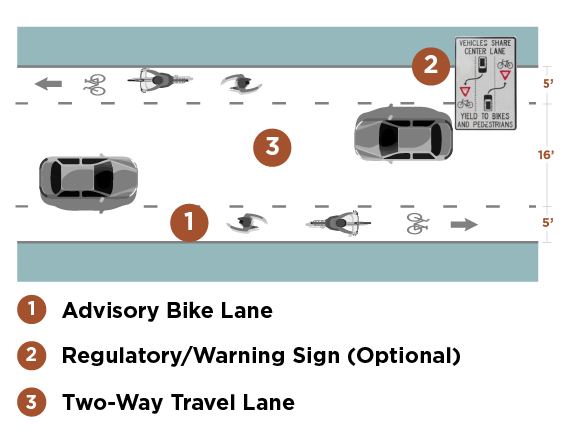
Typical advisory bike lane configuration.
Following a trial period, an evaluation will be done before the FHWA renders approval to continue utilizing the advisory bike lanes configuration.
Advisory bike lanes are envisioned to be implemented on low-volume, low-speed, two-lane roads and create a shared-roadway experience requiring vehicles to merge and yield to one another, as well as people biking. A single, center lane supports the two-way motor vehicle traffic. By simply reallocating the space, advisory bike lanes can utilize the existing roadway paving dimensions. Whether implemented in a rural location, or an urban setting, our team of professional planners has the knowledge and tools required to garner public support for this affordable alternative to new trail construction.
While National Bike Month is an important yearly event, our team is at work year-round to help bring better biking facilities to the clients and communities we serve. Our comprehensive knowledge of current and emerging industry best practices, along with the U.S. Department of Transportation (DOT) and state DOT bicycle and pedestrian accommodation policies help to guide us in our continuing quest to design and implement world-class biking infrastructure.