
In 2025, Iowa saw its lowest number of deaths from car crashes in a century. The Iowa DOT credits vehicle safety improvements, law changes and enforcement, and road improvements over the past 50 years. Snyder & Associates appreciates the opportunity to assist our public agencies with implementation of the Proven Safety Countermeasures that contribute to the reduction in severe injury crashes.
These roadway improvements include safety countermeasures such as:
Road Diets
- Road Diets (4-lane to 3-lane conversions) consist of reconfiguring the existing roadway to improve safety and provide better mobility and access for all road users. A Road Diet typically involves converting an existing four-lane undivided roadway to a three-lane roadway consisting of two through lanes and a center two-way, left-turn lane. This style of lane alignment is designed to reduce traffic speeds, reduce crashes, and provide additional space between vehicles and pedestrians without any physical roadway widening or right of way needs.
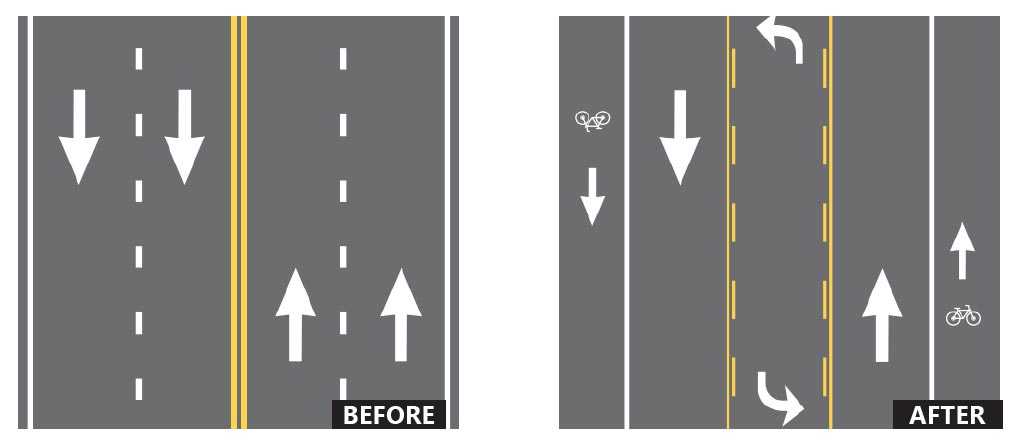
The image on the left depicts a four-lane undivided roadway. The image on the right shows the road after being reconfigured into a three-lane roadway consisting of two through lanes, a two-way left-turn lane, and potential for a bike lane.

Road Diet designed by Snyder & Associates, resulting in improved safety along 5th Avenue South in Fort Dodge, IA. The crash rate reduced by approximately 45 percent after its implementation.
The crash rate along 5th Avenue South from Jan 2009–July 2012 was 440 crashes per hundred million vehicle miles travelled. The crash rate from Jan 2022–May 2025 was 243 crashes per hundred vehicle miles traveled. The road diet was implemented in 2014.
Bicycle Lanes
- Bicycle lanes create a separate, safe space for riders of all abilities. Most fatal and serious injury bicyclist crashes occur at non-intersection locations, nearly one-third occur when motorists are overtaking bicyclists. Bicycle lane additions can reduce crashes up to 49% for total crashes on urban 4-lane undivided collectors and local roads. They can reduce total crashes on urban 2-lane undivided collectors and local roads by up to 30%.

The photo shows the Aurora Ave and 72nd St intersection in Urbandale, IA. The newly reconfigured Aurora Ave corridor from 86th to 70th Streets includes a road diet with bike lanes and left turn lanes at key intersections.
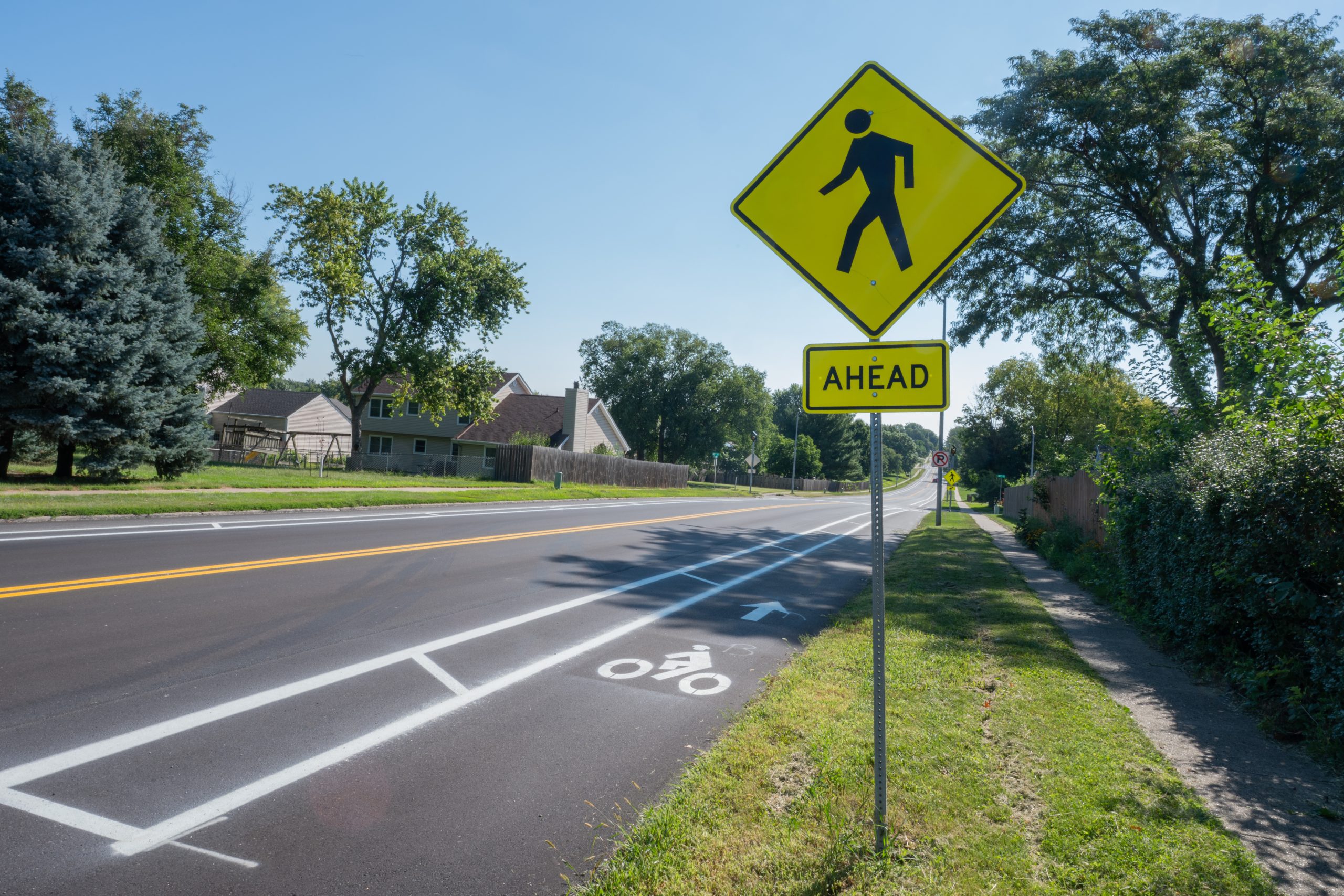
By adding bike lanes to Aurora Avenue, bike riders of all capabilities have an independent lane for travel.
Roundabouts
- Roundabouts feature curved approaches to a circular intersection that reduce vehicle speeds and require entering vehicles to yield the right-of-way to circulating traffic. The circular configuration reduces conflict points and creates shallower collision angles than traditional intersections, decreasing fatal and injury crashes by 78% compared to signalized intersections. Converting a two-way stop-controlled intersection to a roundabout can reduce fatal and injury crashes by 82%.

Aerial view of the completed roundabout at Mount Vernon Road and 10th Street in Cedar Rapids, designed to streamline traffic and enhance pedestrian access.
By implementing road safety improvements like these, we continue to assist Public Agencies with the potential to maintain the downward trend of severe injury crashes in 2026, and beyond. Safety is at the core of our traffic engineering services. Our team uses on-site assessments, crash data analysis, and advanced modeling to evaluate existing conditions and deliver solutions crafted to your community’s needs. Our goal is to build efficient, safe transportation networks that serve all roadway users.