Urban Tree Planting Efforts Provide Far-Reaching Benefits
While roadways and transportation corridors are critical pieces in a community infrastructure puzzle, the landscaping chosen to complement and enhance streetscapes is equally important. If properly planted, managed, and maintained, urban landscaping efforts can provide significant social, economic, and environmental benefits. As one of the largest features in a transportation corridor landscape plan, trees play a critical role in the health and vitality of this urban forest. Healthy trees in an urban landscape provide a wealth of benefits to neighborhoods and residents through the removal of pollutants from the air and water, the reduction of energy consumption and stormwater flows, and increased valuation of private property. At the same time, certain stresses from the urban environment including air pollution, infrastructure conflicts, road salt usage, pests, and maintenance neglect reduce the range and magnitude of these benefits and may lead to tree-related problems.
It’s also no surprise that trees in urban environments are often planted in locations where they’re surrounded by broad swaths of concrete. The impervious nature of concrete, as well as the extreme soil compaction required to support the concrete, inhibit healthy tree growth along corridors. These harsh conditions demand the use of proper planting methods and the utilization of the best tree planting technology to help establish a healthy, thriving environment. The landscape architects with Snyder & Associates are seasoned professionals in the design of corridor enhancements and are well-versed in all aspects of urban tree-planting essentials.
Effective Methods for Planting & Growing Healthy Urban Trees
Proper Principles of Tree Selection
Several basic principles should be adhered to when designing a transportation corridor or urban tree-planting scheme. Foremost of these essential rules is the selection of the proper tree for each growing location. Not only should this include a diverse selection of species, but also the appropriate type of tree for the specific site conditions. Particular attention should be paid to the growth patterns of the trees used to minimize site line obstructions for motorists and pedestrians, soil conditions, moisture levels, as well as the proper spacing from each other and the surrounding infrastructure.
Established, Healthy Trees are Essential
With the proper trees selected, care must be taken to ensure the planting process begins with healthy trees. Disease-, insect-, and damage-free trees are essential for ensuring strong root development, providing the best chance for the tree’s long-term health. In addition to ensuring trees are free from harmful influences, landscape architects or a certified arborist can check for other critical features, such as a healthy root system that shows no signs of girdling (common with container-grown trees). An expert can also identify the presence of a dominant leader branch which signifies a sound tree structure important to overall healthy tree growth.
Suitable Planting Depth & Mulching
The importance of proper planting depth can’t be overstated for the long-term prospect of a tree reaching maturity. The general rule of thumb is the root collar and flare should be exposed above the ground. In some cases, this may require removing a slight amount of soil from around the trunk to determine the right location. If planted too deep or covered in mulch, the root collar exchange of gases can be diminished, killing phloem cells and disrupting the movement of food (photosynthate) to the roots. This will eventually cause root dieback, in turn reducing water uptake, limiting growth, and potentially causing tree death. If planted too shallow, a tree’s growth can be substantially slowed.

Properly applied mulch aids in healthy tree growth by insulating the soil.
The roots that are supposed to grow horizontally have nowhere to go, stopping at the edge of the planting hole or growing into the mulch. Speaking of mulch, if applied correctly, newly planted trees greatly benefit from the addition of this organic material. Mulch insulates the soil, which provides a buffer from heat and cold. It retains water to help the roots stay hydrated and it keeps weeds out to help avoid root competition. However, it’s also possible to apply too much mulch. Piling mulch too high and covering a tree’s trunk, known as volcano mulching, can cause decay. The best practice calls for keeping mulch 6-inches from the tree trunk.
Soil Quality and Adequate Volume Aid the Urban Canopy
Just as important as tree selection, health, and planting method are the quality and volume of the soil in the planting area. Healthy soil provides a reservoir for nutrients and water, a habitat for bacteria and fungi that break down organic matter, habitat for insects and other animals that mix the soil, and of course, a medium for anchoring plant roots. Most trees require specific soil conditions to do well, yet we sometimes take them for granted and assume they’ll grow in any soil. Many tree problems in urban areas are traceable to changes in the physical or chemical aspects of the soil. Also, human intervention (grading and construction activity) can quickly alter the properties of the soil, impacting a tree’s ability to survive. Understanding the effects of these impacts on soil and tree health, and learning how to improve them, is a chief concern of the experts at Snyder & Associates.
Budget-Friendly Methods to Increase Soil Volume
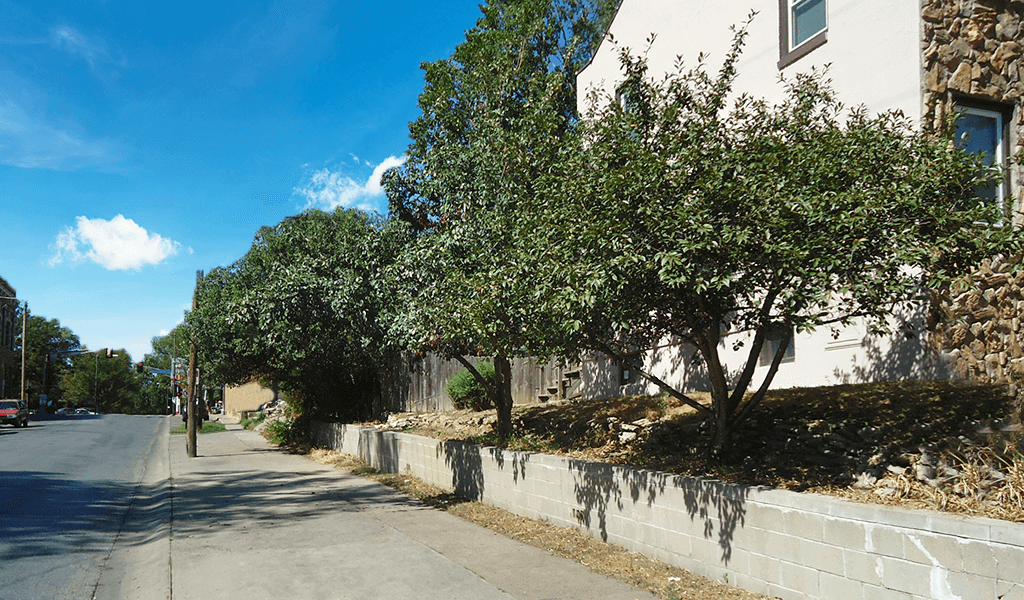
Raised planting areas help to protect trees from damage and contaminants.
While several methods exist to increase the quality and volume of soil, some are more cost-effective than others. Primarily, the creation of large planting beds (where space allows) can be a better way to maximize the soil volume and protect the tree’s natural root flare. The use of raised curbs around the planting beds also helps to minimize salt contamination and discourage people from walking in the beds and compacting the soil.
The addition of curb cuts can be implemented to allow stormwater runoff to reach the planting areas. Our experts often recommend the addition of sub-drains and amended topsoil to the planting beds to address compaction and potential drainage concerns caused by typical road construction practices. Urban conditions do not always allow for large, combined planting beds and other technical methods need to be considered.
Manufactured Technologies for Increasing Tree Access to Soil Volume
It’s no mystery that trees require an adequate supply of well-aerated, moist, and uncompacted soil to thrive. However, as previously mentioned, the conditions surrounding transportation corridors rarely create these ideal conditions. So when it’s not possible to utilize large planting areas, many situations call for alternative technologies to aid healthy tree growth. Two such technologies are the use of structural soil and/or structural soil cells.
Structural Soil
When root growth is restricted, overall tree growth suffers as water, nutrients, and oxygen are limited. The need for load-bearing soil under pavement gave rise to the development of structural soil. Structural soil consists of a specific blend of compactable gravel and soil for use as a concrete base. This mixture is designed to have enough strength to support pavement installation requirements while permitting root growth through the “channels” created by the soil in the mixture. It provides a high-strength pavement system that allows for more streetscape landscaping options.
Structural Soil Cells
Another option available for use around transportation corridors is structural soil cells. These structural or “root” cells are modular units, often made from recycled polymers that assemble to form a skeletal matrix. They’re positioned below the pavement to support the pavement load while also providing space for a large volume of uncompacted, loamy soil within the matrix structure to allow for root growth. While this method typically has a higher initial cost compared to other options, studies have shown that trees grown in the suspended pavement over loam soil were taller, had broader canopies with significantly larger, greener leaves, and had better long-term growth prospects than those in structural soils. This also includes trees with limited access to soil infrastructure due to compaction or pavements.
Best Practice Solutions for Enhancing & Caring for the Urban Forest
The expansive list of benefits provided by healthy, well-planned transportation corridor landscaping can’t be overstated. The keys to a successful and long-lived urban forest lie in the planning phase and the initial first steps before a single shovel of dirt are turned. Having an expert team of landscape professionals in your corner is a critical decision for long-term success. The Snyder & Associates team stands ready to lend their years of collective knowledge and best practice solutions to help guide your project.