Planning for Multimodal Transportation Amenities
Complex infrastructure projects can be a hassle for the traveling public. When roadways, sidewalks, and the surrounding landscaping are disrupted for renovations or reconstruction, commuters are often left scrambling to find alternative routes to their destination. But these crucial transportation and utility projects also create an opportunity to improve the multimodal accommodations of corridors and make them more “complete” for all users.
Complete Street components are generally identified through transportation master plans or corridor studies that are performed in advance of infrastructure projects. Using these plans and studies as a foundation, our transportation experts work closely with client communities to develop the detailed design of those complete street elements (bike lanes, transit stops, pedestrian crossings, etc.) that ultimately help complete the multimodal transportation networks envisioned by our clients.
For the Snyder & Associates team, this centers around ensuring the multimodal transportation systems that we recommend are appropriate for our client. We aim to right-size our solutions for promoting public transportation, bicycle, and pedestrian travel, improving accessibility and connectivity between modes (transit stations, intermodal terminals, bicycle, and pedestrian facilities), and coordination with land use. And when we incorporate these improvements with already-planned utility or roadway infrastructure projects, the cost savings to our client communities can be substantial.
Complete Street Solutions in Action — Central Iowa Case Studies
The University Avenue “Complete Street” Project that our team completed for the City of Des Moines is one example of building above-ground transportation amenities in conjunction with below-ground infrastructure improvements. Situated between 25th and 30th Streets along University Avenue, these multimodal upgrades were part of our Near West Side Sewer Separation Phase 3 project that allowed us to put something back in place that is better than what was there before.
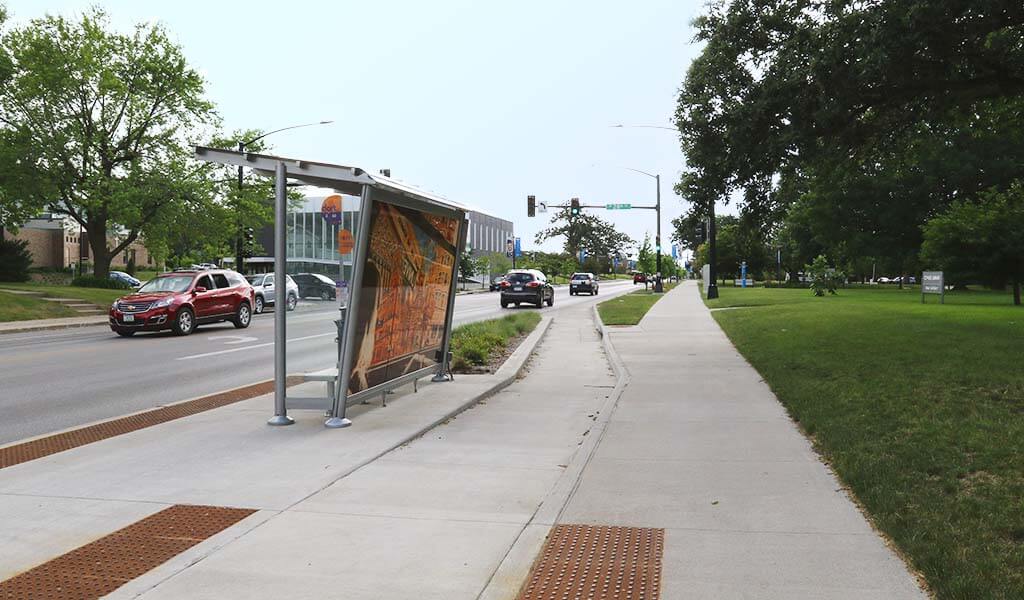
Diverting the bike lane behind the floating bus island creates a much safer environment for users.
The sewer project involved the removal of the street pavement and bike lanes to accommodate the sewer work. Above ground, we reduced travel lanes from five to three to slow vehicle traffic and provide space to move the sidewalks away from the street.
Our team was also able to provide a new space for bicycles using on-street bike lanes. And at several bus stop locations along the corridor, the bike lanes divert behind the bus stop, creating a “floating bus island” to improve the interaction of buses, bikes, and pedestrians either using the bus or walking along the corridor. While floating bus islands are a relatively new approach in Iowa, this unique solution shows a commitment by communities to prioritize the more vulnerable transportation network users over vehicular traffic.
In a similar vein, our 6th Avenue Streetscape Project in Des Moines began as a years-long green stormwater infrastructure project. Stretching along 6th Avenue between University and College Avenues, we also began by reducing travel lanes from five to three. But instead of floating bus islands, the added space allowed us to move the sidewalks away from the street, making it much more comfortable and safer to walk along and across 6th Avenue.
Additionally, we were able to provide a new space for bicycle lanes on the west side of the street that connects to the local trail network. This too was a new approach in Iowa for providing separate routes for both bikes and people walking, where it’s usually a shared space.
Complete Street Solutions in Action — Eastern Iowa Case Studies
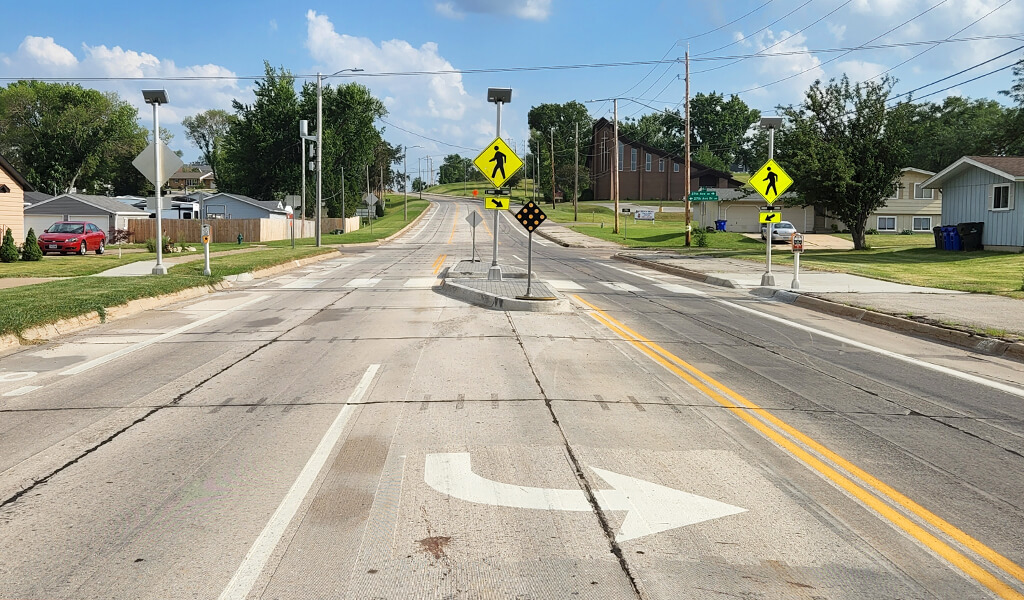
Pedestrian “refuge islands” make it safer for people to cross a street with busy traffic.
In eastern Iowa, our team has introduced similar multimodal solutions as part of larger infrastructure projects. The recently designed Bowling Street SW four-lane to three-lane conversion in the City of Cedar Rapids greatly improved this corridor between 50th Avenue SW and Wilson Avenue SW. These improvements were a part of a roadway rehabilitation project to improve the condition of the pavement, reduce the travel lanes, and provide the space for on-street bike lanes.
The corridor is situated among a mixed-use of industrial and residential properties and has experienced high crash rates. Higher traffic speeds also limited the safe crossing of pedestrians. Our team effectively reduced the travel lanes and added left-turn lanes along Bowling Street SW. More importantly, we designed a space between the trail and the street, making it much more comfortable and safer to walk along and across Bowling Street SW. An upgraded mid-block pedestrian crossing created a pedestrian “refuge island” and the addition of Rectangular Rapid Flash Beacons provides a safer pedestrian crossing.
 Just down the interstate highway in Iowa City, Mormon Trek Boulevard was also the beneficiary of several multimodal improvements. This project was completed in support of the overall implementation of the community’s 2017 Iowa City Bicycle Master Plan. The stretch of Mormon Trek Boulevard between Highway 1 and Melrose Avenue was identified as a high priority to construct buffered bike lanes in conjunction with a road diet.
Again, reducing the travel lanes from four to three provided more space between the sidewalk/trail and the street, making it much more comfortable and safer to walk along and across the corridor. Due to the higher volume and faster-moving traffic along Mormon Trek Boulevard, buffered bike lanes provided better separation between bicyclists and vehicle traffic, creating a safer environment.
Maximizing Transportation Project Benefits with Complete Streets Components
The Snyder & Associates team has been incorporating the latest in complete street elements into our design projects for many years. The projects showcased above are great examples of how our transportation and utility construction projects lead to opportunities to improve the multimodal usage of corridors and make them more complete for all users.