

For spectators, watching a football or soccer game in rainy, snowy, or muddy conditions can be quite entertaining, especially as the game wears on and the field and players are reduced to a muddy mess. While the players can easily hit the showers, the playing field is another story. These occurrences keep field and sports turf managers awake at night, as they’re tasked with getting the field back to playing shape for the next event, which might be scheduled for the very next day. Whether it’s a high school, parks and rec field, a Division One college, or professional sports field, there are many considerations at play when it comes to sports turf selection and maintenance.

“Artificial and natural grass turf have significant differences, and how your sports field performs is influenced by a variety of factors,” according to Clay Schneckloth, a Landscape Architect at Snyder & Associates, an Iowa-based firm specializing in engineering, planning, and design services. Schneckloth’s firm has worked on a number of athletic facilities in the parks and school sectors, including new designs and renovations. While natural turf is still standard, Schneckloth is noticing more small market facilities like high schools turning to artificial turf, which is often due to the number of events they’d like to schedule.
“With artificial turf, they’re not having to ‘rest’ the field like you might have to with natural turf to allow it to recover from the activity; they can schedule activities back-to-back and not have to worry about the natural turf getting beat up or destroyed. Also, after a rain event, they’re able to get back on the artificial turf much sooner than a natural turf field.” Of course, many athletes prefer natural turf, though there are certainly maintenance challenges. “A turfgrass field needs a strong root system to flourish and withstand repeated use,” said Schneckloth. “And establishing a strong root system begins with the right conditions.”
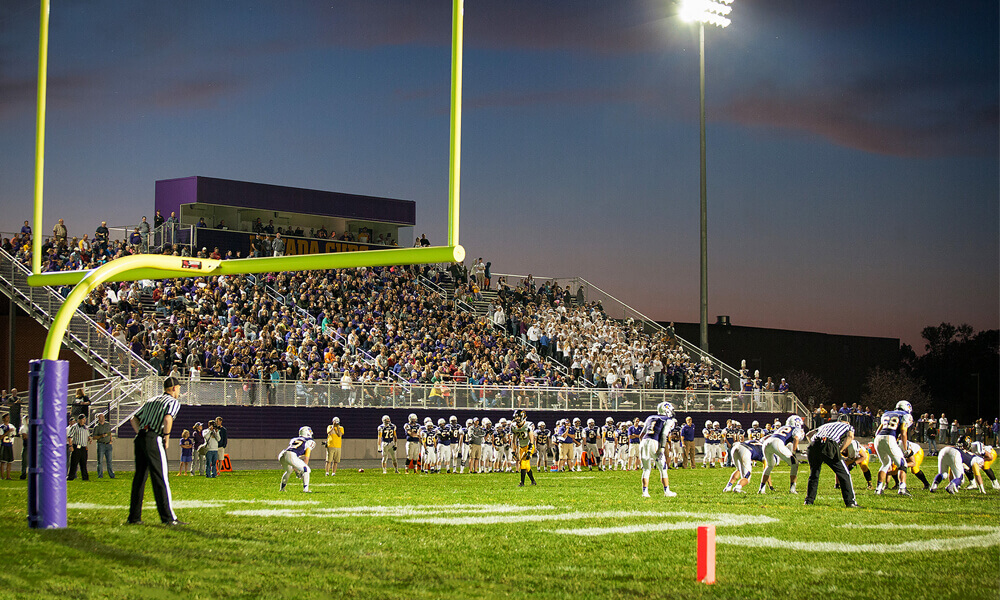
The Nevada Cubs Stadium has a natural turf field comprised of Kentucky bluegrass and perennial ryegrass. Drainage and irrigation components were included during field construction to assist with turf establishment and long-term health.
On projects where natural turf is preferred, Schneckloth and his colleagues focus on several aspects of athletic turf design to help fields achieve those conditions and remain game-ready. Funding is also a big consideration, and decisions involving irrigation, drainage, maintenance, and the type of soil and turf species will be affected by budget. The level of play is also a factor—is it a local recreation field or a top college campus?—and of course, the amount of use that’s anticipated for the field, since some might be used just once a week compared to others that might host multiple games on one day. Schneckloth pointed out the importance of irrigation systems. Certain species of turf require more water than others, and sand-based soils typically need more water than native soil fields. Natural turf should be watered deeply, which makes moisture monitoring important. Of course, too much water will impact growth negatively too.
Proper drainage is critical, including surface drainage of surrounding areas. Utilizing an underground subdrain system is ideal, and conducting soil borings and analysis can also drive decisions. “Understanding the soil composition will help determine the design of the subdrain system,” said Schneckloth. “It’s always a good idea to include soil analysis by a geotechnical engineer. Both are a valuable component for a healthy natural turf.”
For many natural turf fields built on native soil, drainage can be a big problem. But budgets might not be large enough to install a synthetic field. Another option is installing a sand-based field, which involves excavating a foot or more of soil, installing drain tile, a gravel layer, and a sand-based root zone. Another option is the sand cap model, which is less expensive because only a small layer of topsoil is removed from the field and replaced with a layer of specifically blended high sand-based root zone material. The turfgrass is then reestablished from seed. Installing a drain system is also necessary.
Finally, Schneckloth explained that it’s important to develop a maintenance plan. “Constructing or renovating a sports field is a large capital improvement. Keeping the field in top performance shows responsibility for the investment and (means) safety for the users of the field. The maintenance plan will help guide the timing and budgets needed to properly care for the field.”
Multiple Fields, Multiple Sports
The Iowa State (ISU) Cyclones boast a proud sports tradition, and their football team—which competes in the Big 12 Conference—had a standout year this past season. Adam Thoms is the assistant professor of commercial turfgrass there, helping to troubleshoot turfgrass problems for the turf managers at ISU’s athletic department, who maintain nine natural grass fields and two synthetic fields. Thoms and the athletic department shared some insights involving their work, agreeing that weather is a big challenge.
“Some years it rains a lot, and it’s hard to get the turfgrass roots to go deeper into the rootzone. Drier years it’s actually easier because we can just add the water we need and drive the roots deeper, making a stronger playing surface,” said Thoms. Thoms explained that climate makes a big difference in which type of turfgrass grows best and how you would maintain it. “In the southern U.S. it would be bermudagrass, and more northern areas is Kentucky bluegrass. Some areas use bermudagrass overseeded with perennial ryegrass during the fall and winter months. Each turfgrass has its own requirements, but at the end of the day there’s a turfgrass that performs well in every part of the United States.”
This article has been reprinted with permission from Recreation Management and is written by Dave Ramontt.