Elevated Levels of PFAS in Drinking Water Linked to Adverse Health Problems
Recently published scientific reports have become the focus of concern across the water industry as increasing levels of potentially toxic chemicals are detected in drinking water supplies. Per- and poly-fluoroalkyl substances (PFAS) encompass more than 4,000 substances in consumer products like food packaging, stain-proof rugs, waterproof clothing, nonstick cookware, and firefighting foams. In 2016, the U.S. Environmental Protection Agency (EPA) announced a health advisory for PFAS that created the lowest concentrations ever established for a contaminant, at 70 parts per trillion (ppt) in drinking supplies. This directive was based on mounting research linking PFAS to a wide range of health problems, including multiple types of cancer, thyroid disease, liver damage, and premature birth, to name a few. Currently, there are no regulations for PFAS chemicals in public water systems.
Practical & Pervasive Chemical Substance Infiltrates Water Supply
Due to a chemical structure containing linked chains of carbon and fluorine, PFAS are long-lived substances that can repel water and oil, making them highly durable and resistant. However, these properties that make PFAS useful in a wide array of consumer goods are the same ones that make them highly persistent in the environment. PFAS are known as “forever chemicals.” Once they are in the environment, they do not break down. Instead, they continue building up in our ecosystems, source water, and bodies.
While this multitude of manufactured chemicals surrounds us in our daily lives via the products we use, PFAS mainly contaminates water supplies through two primary sources: industrial discharge and fire suppressant foam. Fire suppressant foam has been employed at numerous military bases nationwide and airports worldwide for decades. Once the foam is dispersed, it sinks into the surrounding soil, enters the groundwater systems through stormwater runoff, and slowly spreads the contaminants. Estimates concerning the amount of contaminated drinking water supplies differ based on testing practices and location. The Environmental Working Group, a consumer-education nonprofit, estimates that “1,500 drinking water systems across the country may be contaminated, affecting 110 million Americans.”
Potential Impending Regulation Changes for Treatment Facilities
So, what does this potential shift in the rules mean for your community? With impending regulation changes, facility updates are seemingly inevitable. At Snyder & Associates, our environmental scientists and water source professionals stay on the cutting edge of new technology. They are well-versed in enacting proactive measures to tackle new regulations. Whether you need to improve an existing water treatment plant or design an entirely new facility, we know that cost-effective and intelligent solutions begin with proper testing. Data quality and reliability are critical when testing concentrations in parts per trillion. We have established strong relationships with local agencies and can quickly coordinate the proper testing protocols and communications for individual facilities. Once results are verified, our team can help determine the best action to mitigate PFAS, along with most other water parameters and contaminants such as hardness, iron, manganese, nitrate, and ammonia.
Determining Cost-Effective Treatment Options to Mitigate PFAS
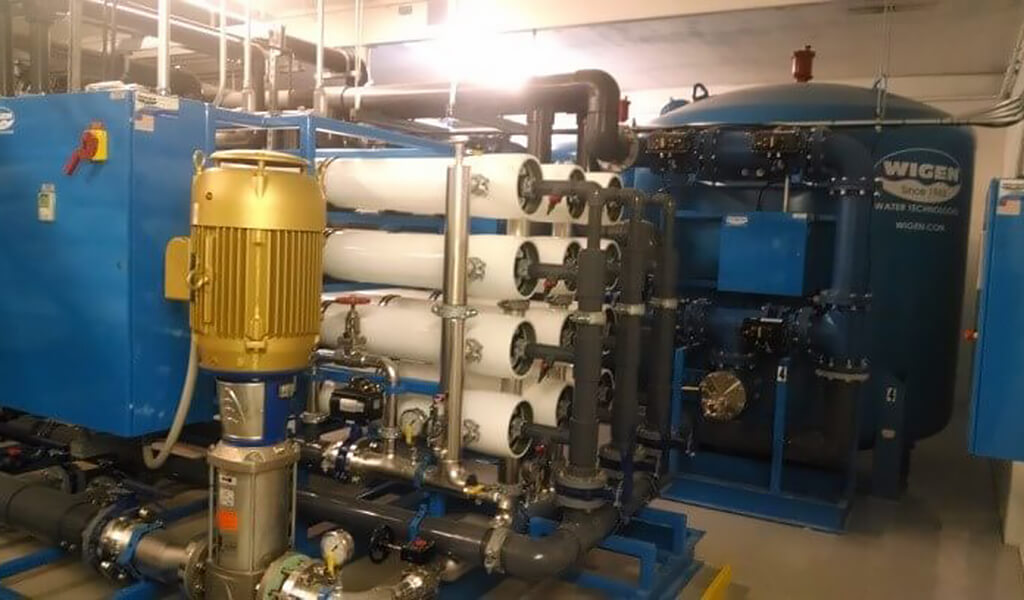
A reverse osmosis system, similar to the one used in Creston, Iowa, is proficient in removing PFAS from drinking water.
Today’s water utilities have several options for removing PFAS from their water supply. Granular Activated Carbon (GAC), ion exchange, and Reverse Osmosis (RO) are the three most widely accepted techniques. As with most technology, several elements must be considered when deciding on the right solution for your situation. Maintenance requirements, operational feasibility, and overall costs should all be weighed against the community’s overarching needs. Our team helps select the right treatment option after a thorough and unbiased evaluation of the facts. Whether retrofitting an existing facility or designing a new one, we can present recommendations for the treatment process that provides the proper balance for your community.
Funding & Permitting Assistance for Water Quality Improvements
Snyder & Associates understands that most utilities face an uphill battle to keep their systems up-to-date and compliant. Fortunately, state and federal funding is available in many locations to help relieve communities’ financial burdens. With years of knowledge and experience with outside funding sources, our team can guide you through the necessary steps to acquire critical project funding.
No matter where your community is located, we’ll assist you in navigating all program requirements and completing and submitting funding applications. Likewise, our team can coordinate the extensive permitting process for water quality improvement projects. Our experience and relationships with regulatory agencies help to keep projects on schedule and budget.
Addressing PFAS in Your Community’s Water Supply
Snyder & Associates collaborates with clients and regulators to develop a comprehensive understanding of PFAS chemicals and works towards providing accurate information while devising sustainable solutions. If you are apprehensive about the possibility of your community having high PFAS levels in the drinking water supply, our team is ready to formulate a plan that caters to your community’s needs while adhering to the current and future water quality regulations.