

Significance & Purpose of Dams
For centuries, dams have played an important role in the vitality of lake and river communities. They are used to generate electricity, reduce flood risks, store water, and provide irrigation to the surrounding area. Dams and spillways also ensure consistent water levels for recreational use and assist with nutrient storage. For decades dams were a sign of progress and man’s ability to harness the power of nature. However, due to a plethora of energy options now available, that’s changing. “Dams must be installed and maintained properly. There’re also an outdated, failing infrastructure to consider that’s often economically unfeasible to maintain or replace,” explains Wes Farrand, Civil Engineer for Snyder & Associates.
Determining the Cost & Funding of Dam Removal
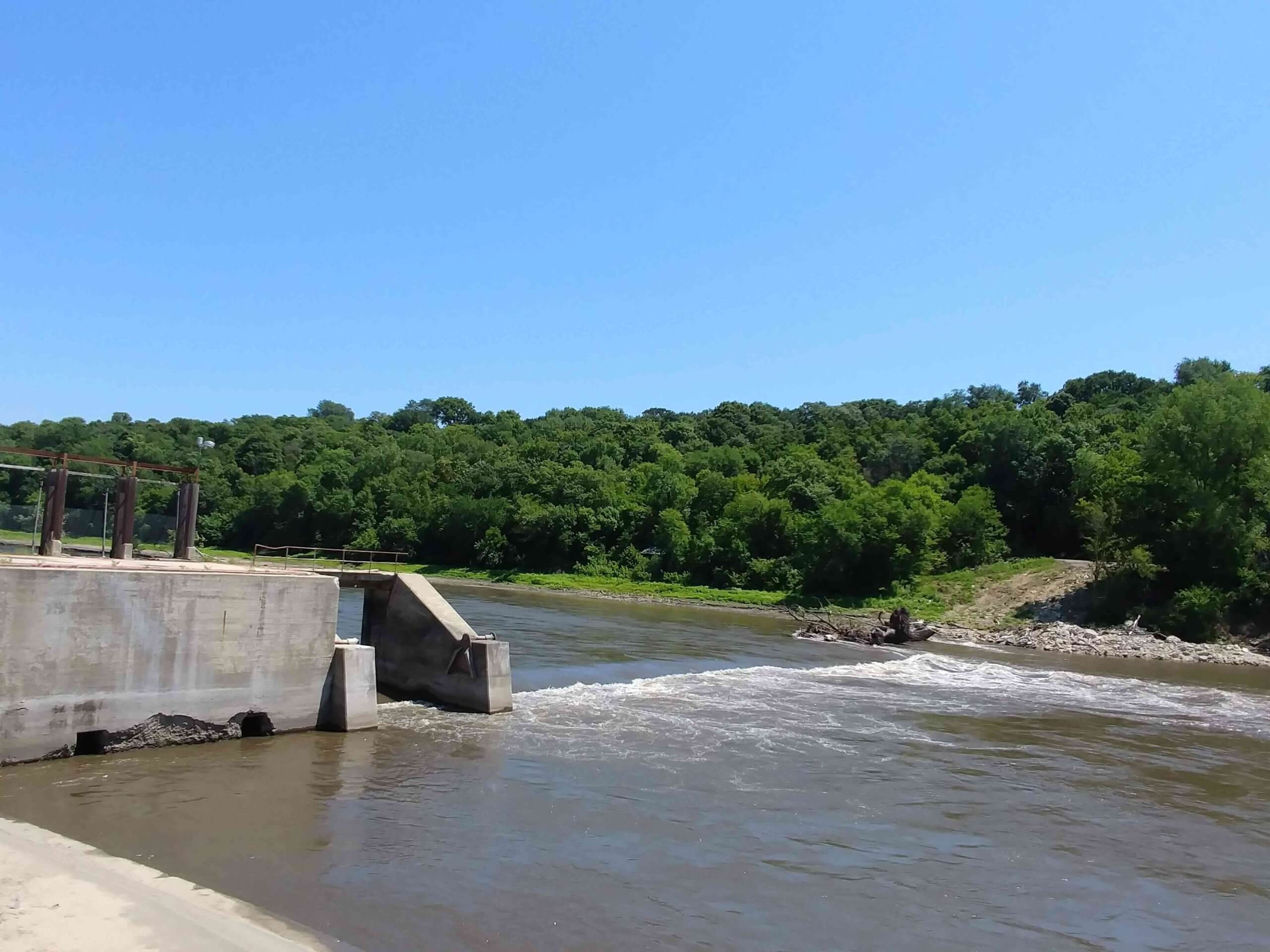
Little Dam was considered a Low-Head dam which conveys significant safety issues.
There’s a direct relationship between the size and complexity of a dam and the cost to remove it. A small, earthen dam may cost tens of thousands of dollars to remove while a low-head dam removal could cost hundreds of thousands of dollars. Removing a large, concrete dam can easily run into the millions of dollars.
Many funding assistance options are available through agencies and foundations that provide assistance for river restoration and dam removal. Examples of funding options include the Clean Water State Revolving Fund (CWSRF) and EPA grants (Clean Water Act and Section 319).
Overall Safety Improvements
The water near a dam may appear calm and smooth, but it’s often too strong for boaters and swimmers to safely navigate. Strong turbulence and recirculating currents can easily push boats and people underwater, and then pull them back to the face of the dam in a repeating cycle. Every year, dozens of people drown near dams in the United States. Deconstructing a dam removes that safety hazard.
Additionally, without consistent monitoring and maintenance, small earthen dams will deteriorate and fail. The incredible volume of water that releases when an earthen dam fails poses a serious safety risk and can cause devastating damage downstream. The safety risk presented by dams is further illustrated with two recent projects our team worked on.
- During the design for low-head dam mitigation and streambank stabilization of Squaw Creek in Ames, Iowa, two kayakers were taken to the hospital after they nearly drowned. In reflecting on the project, Snyder & Associates Civil Engineer Steve Klocke said, “It’s good to know that the hazard has been eliminated and the site is now safer for recreational use.”
- Prior to removal of the Hydroelectric Dam in Fort Dodge, Iowa, a young man lost his life after his kayak capsized. Tony Trotter, the City Engineer for Fort Dodge, said the accident solidified their decision to move forward with the dam removal project.
Increased Recreational Opportunities through Dam Removal
Removing a dam increases recreation options in the water and along the adjacent shoreline. Navigable waterways are extended through dam removal, allowing boaters and kayakers to explore areas that were once too dangerous. Anglers also benefit due to an increase in fish species diversity and longer migration lengths following a dam removal. The leftover material from dams can even be used to create new fish habitat in the area.
Several dams across Iowa and the Midwest have been removed or modified to support whitewater recreation. This has the added benefit of bringing in thousands of tourism dollars from out of town visitors. The City of Fort Dodge plans to incorporate its dam removal project into a larger river revitalization effort. Kayakers and water enthusiasts will be able to traverse rapids north of the former Hydroelectric Dam, through the Central River District and the area of the former Little Dam. The city is also working with Webster County Conservation to improve whitewater opportunities on Lizard Creek.
Dam Removal Provides Environmental Lift
Originally, dams were designed to control water, period — and the environmental impacts weren’t fully considered. Decreased water quality, disrupted cyclical stream temperatures, and altered natural meander of waterways are a just few ways dams have adversely impacted the environment. Removing a dam improves water quality by allowing water to flow naturally. Natural flows allow for normal sediment load, increased dissolved oxygen, and reduced concentrations of oxygen.

Dam removal takes place in efforts to increase water quality and to improve the community
Fish and invertebrate species greatly benefit from dam removal, as well. Many dams act as barriers because they were designed and constructed without including passage for fish and invertebrates. Dam removal greatly benefits these species by allowing free passage upstream and downstream, which is crucial to migration patterns. In addition, a greater diversity of fish and invertebrate species is often documented both up and downstream following dam removal. Following the removal of the Hydroelectric Dam in Fort Dodge, anglers are now able to catch flathead catfish upstream from the dam’s previous location. According to Nichoel Church, this species of catfish is a big river fish that’s only been observed downstream from the dam prior to removal.
During complete dam removal, rock riffles or series of large boulders are often constructed at dam site to provide in-stream features. Benefits of these features include stabilizing channel beds, providing habitat for fish spawning, reducing velocities, and increasing downstream oxygen levels.
Partial dam removal may be advantageous if full removal would release a significant amount of sediment. For a partial removal, the dam’s height is reduced, eliminating the dangerous recirculating current. Additional boulders or riffles can be added as instream structures here, as well, to reduce downstream velocities.
Following dam removal projects, the banks of the waterway typically recover, developing natural riparian buffers and restoring floodplains. These new areas increase the amount of natural terrestrial vegetation available and improve the ecology of the waterway.
Documentation: The Dam Removal Process
Dam removal can provide significant environmental benefits to a watershed. Determining the correct course of action requires the appropriate level of documentation including river assessments, hydraulic modeling, and cost-benefit analysis.
“Dam removal or modification shouldn’t be taken lightly. It requires research, planning, and critical thinking, along with an innovative approach to design. We’ve enjoyed assisting the City of Fort Dodge and Ames with their dam removal and modification projects and look forward to helping other livable communities,” concludes Jeff Walters, Environmental Sciences Group Leader for Snyder & Associates.