Community Growth Drives Need for Signal Upgrades
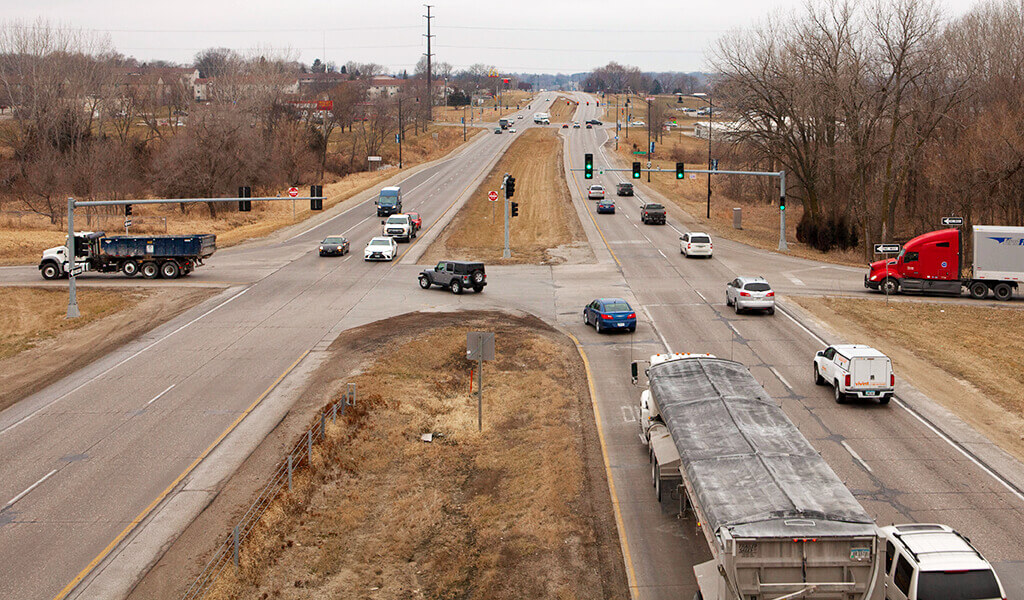
The City of Pleasant Hill, Iowa has turned to Snyder & Associates for professional transportation engineering services on numerous occasions over the past decade. This thriving and growing suburb located east of the Des Moines metro carries a high volume of traffic through town, particularly along the busy Iowa Highway 163 corridor. This corridor has seen many physical improvements and intersection upgrades over the years. However, the existing traffic signal system is not capable of incremental, short-term, or continuous timing changes to automatically accommodate fluctuations in traffic demand without manually adjusting signal timings. This leads to traffic congestion and queuing issues at numerous locations.
To combat this issue, the city decided to investigate the possibility of implementing Adaptive Signal Control Technology (ASCT) at 13 intersections along the busy corridor. This project would include the installation of adaptive signal control technology along Highway 163 at 10 signalized intersections — stretching from Copper Creek Drive to NE 80th Street. It would also include three additional signalized intersections that are adjacent to Highway 163.
What is Adaptive Signal Control Technology (ASCT) for Traffic Signals?
With standard traffic signals, retiming might only occur every few years and is reliant on time-consuming, manually collected data. Even then, standard time-of-day signal timing plans don’t accommodate for variable and unpredictable traffic patterns. This results in more delays due to congested traffic, excess fuel consumption, and frustrated drivers.
Adaptive Signal Control Technology (ASCT) uses sensors to gather real-time traffic information and monitor the system’s performance along an entire corridor. This information is quickly evaluated and signal timing improvements are developed by an algorithm. The ASCT implements the updates continually, sharing information between signals to make timing adjustments. These constant adjustments accommodate traffic patterns that are different from the peak periods (during which the standard signals were designed to operate) and help keep traffic flowing smoothly.
This project includes the installation of adaptive signal control technology along Highway 163 at 10 signalized intersections
Systems Engineering Study Determines Need for ASCT
To determine if ASCT was necessary for this corridor, a systems engineering study needed to be conducted. Based on the strong relationship between the City of Pleasant Hill and Snyder & Associates, our traffic engineers were tasked with performing this study. A systems engineering study is a meticulous process that follows guidelines established by the Federal Highway Administration (FHWA). This type of study is also a requirement of most state DOTs to be eligible for grant and other program funding.
Because there are numerous adaptive control systems available, it’s critical to know the existing conditions of a corridor before issuing a Request for Proposals (RFP). To that end, a systems engineering study looks at peak/off-peak traffic conditions and studies turning movement counts along the corridor. The engineering team also inventories the current signal controller equipment in use, the communications network in the area, and any geometric concerns that may need to be addressed at individual intersections.
Additionally, other improvements to modify signal controller cabinet equipment or update the communication network are considered. Fortunately, all of the intersections in the study group already have relatively modern controller cabinets, signal controller hardware, and a strong fiber optic network from prior traffic signal system projects. Fiber optic connectivity is a strong necessity for most ASCT installations to provide the level of communication necessary for optimal performance.
The systems engineering study also considered the detection system in use along the corridor. Currently, Pleasant Hill uses inductive loop detection at all of the intersections, with video detection at one intersection. The study determined that some of the loops were failing, causing the city to consider switching to a non-intrusive video or radar detection system. Our team provided guidance for possible replacement detection measures for future implementation.
Operational Considerations & Unique Challenges for ASCT Determination
Several important operational considerations along the Highway 163 corridor were taken into account during the study. Foremost was accommodating peak traffic periods, mini peak periods, and near real-time changes in traffic volumes.
There are several event facilities located along or near the corridor. The Southeast Polk School Complex and several churches host various events throughout the year. The Iowa State Fairgrounds (approximately one mile west of the City of Pleasant Hill) hosts the Iowa State Fair annually. Highway 163 is a designated route to the fairgrounds and the Southeast Polk Schools provide a park-and-ride service for fair attendees. An ASCT system would need to handle the increased traffic from such events as they occur.
Returning to normal operation quickly after coordinated signal operations are disrupted by pedestrian actuation and emergency vehicle preemption is another necessity of an ASCT system. Any proposed system should be able to support the existing Emergency Vehicle Preemptive (EVP) system currently in place at all intersections. Since there is limited pedestrian activity along the corridor, the proposed system should be able to accommodate the pedestrian demand, while minimizing impacts to vehicle traffic.
Queue management was also a study focus along the corridor, including the US Highway 65 ramp intersections. Heavy queueing concerns at both ramp intersections can impact through-traffic operations along Highway 65. Additionally, the NE 56th Street intersection was notable for experiencing periodic queueing problems that impact traffic flow along the corridor.
Funding & RFP Assistance
The results of the extensive systems engineering study determined ASCT would be the proper solution for the issues plaguing the Highway 163 corridor through Pleasant Hill. To facilitate the process, Snyder & Associates assisted the city by compiling and submitting an Iowa Clean Air Attainment Program (ICAAP) funding application with the Iowa DOT. Approximately $580,000 in ICAAP funds would be used for the engineering study, as well as procuring and installing the ASCT system.
Additionally, the Snyder & Associates team wrote the extensive RFP submittal. As proposals are received, our team will also help the city determine the best vendor to implement its ASCT solution. The future success of this project will be measured by a notable reduction in intersection delays and travel times along Highway 163 in Pleasant Hill. This will result in a reduction in vehicle emissions and pollutant output caused by stopped vehicles and excessive idling. The deployment of an ASCT system along this corridor will also allow the city to proactively manage traffic, enhance operations, increase mobility, and reduce congestion.