Identifying Funding Application Options for Water Quality
For nearly 25 years, Snyder & Associates has had the privilege of serving as the City Engineer for the City of Pleasantville. As their City Engineer, it’s not just about one project, but a dedication to a successful client relationship. Collaborating on a variety of projects, including site plan reviews, street reconstruction projects, and stormwater improvements has allowed for a strong relationship between city staff, community stakeholders, and Snyder & Associates. Our work has extended into their wastewater treatment plant design, where we assisted the City in securing Clean Water State Revolving Funds (SRF) money for the construction of a Sequencing Batch Reactor (SBR) treatment system. Through this effort and Snyder & Associates’ understanding of the SRF process, we recognized an opportunity for the City to apply for Clean Water SRF sponsored project funds. In consulting with the City regarding the option to apply and reviewing areas where there were water quality concerns, the decision was made to proceed with water quality improvements at Shadle Park. Located near community schools, Shadle Park is home to Shadle Pond, which is a popular fishing and recreation area. To protect local surface water and connecting bodies of water, the primary recommendation of a watershed study we completed for the City was to improve water quality within and exiting Pleasantville.
Recommended Stormwater Management BMPs
As required by the SRF funding application, Snyder & Associates completed a watershed analysis and inventory, encompassing Shadle Park. A visual assessment was completed through collaboration with the City of Pleasantville and the regional IDALS Urban Conservationist.
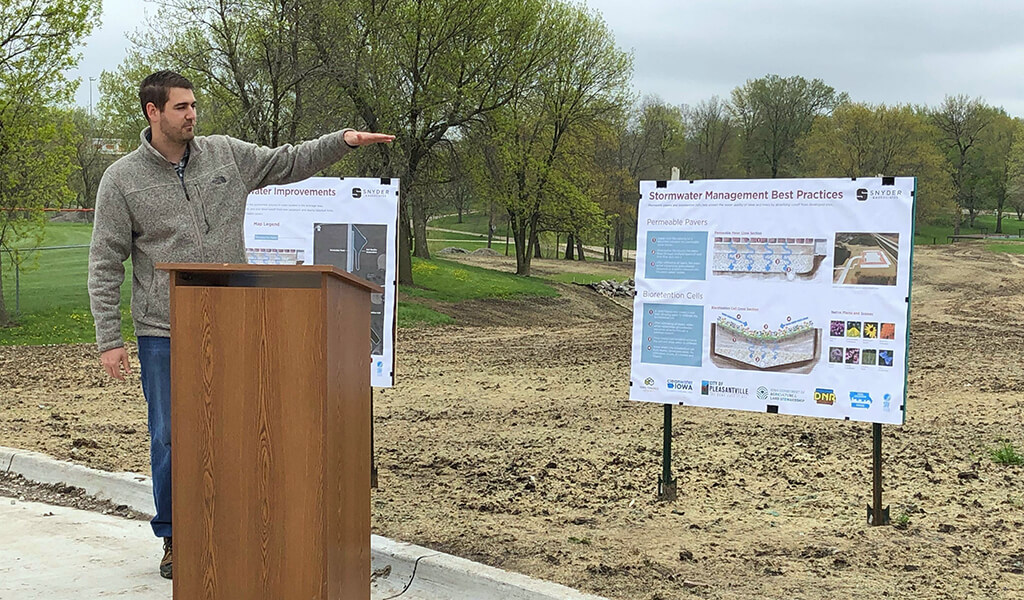
Jordan Stoermer, P.E., Civil Engineer with Snyder & Associates, speaks to the public about the stormwater management best practices used at Shadle Park.
We analyzed water quality data for the Red Rock Reservoir that was collected by the Iowa DNR, Iowa State University, and USACE. The data focused on several important indicators of environmental health including dissolved oxygen (DO), E. Coli and fecal coliform bacteria, nitrate and nitrite, ammonia, phosphate, and turbidity. Through data analysis, we confirmed the need for practices to improve water quality. We recommended six stormwater management BMPs: Bioretention cells, bioswales, native landscapes, permeable pavement, forebay rehabilitation, and soil quality restoration.
Bioretention Cells
Bioretention cells, including rain gardens, are shallow stormwater basins that use engineered soils and vegetation to capture and treat stormwater runoff. Water either partially infiltrates, fully infiltrates, or returns to the conveyance system. They’re designed to reduce runoff and treat pollutants such as nitrogen and phosphorus. Bioretention cells will be placed in the southwest corner of the northernmost ball field at Shadle Park. They’ll also be placed at the local high school or elementary school. The cells will contain engineered soil and rock layer to allow for maximum infiltration as well as native plants with deep root systems. The majority of pollutants will be removed, making this an ideal method of achieving the project goals.

Bioswales
Bioswales are open channels of vegetation that treat stormwater runoff. They can be designed as wet or dry cells and are controlled by structures such as check dams. We determined a bioswale in Shadle Park would help improve water quality and quantity. One of the main drainage channels in the park is approximately 330 feet long and could be converted to a bioswale. It will be designed for infiltration and contain native plants.

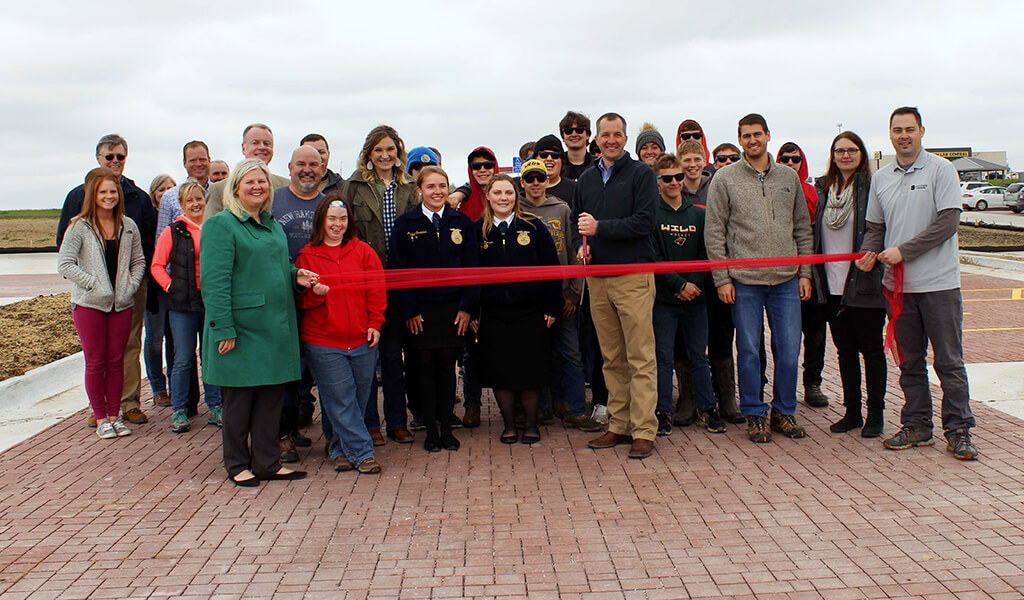
As part of an educational component of the project, students from Pleasantville School District installed native prairie plants in the bioretention cells.
Native Plant Restoration
Strategic plantings of native prairie and woodland species reduce and treat stormwater runoff while repairing soil health and beauty. Approximately 85,000 square feet of native plants will be grown strategically throughout the park and at least 20 feet around all forebays. This will help meet water quality and quantity goals, break up high runoff areas, and provide native habitat.
Permeable Pavement
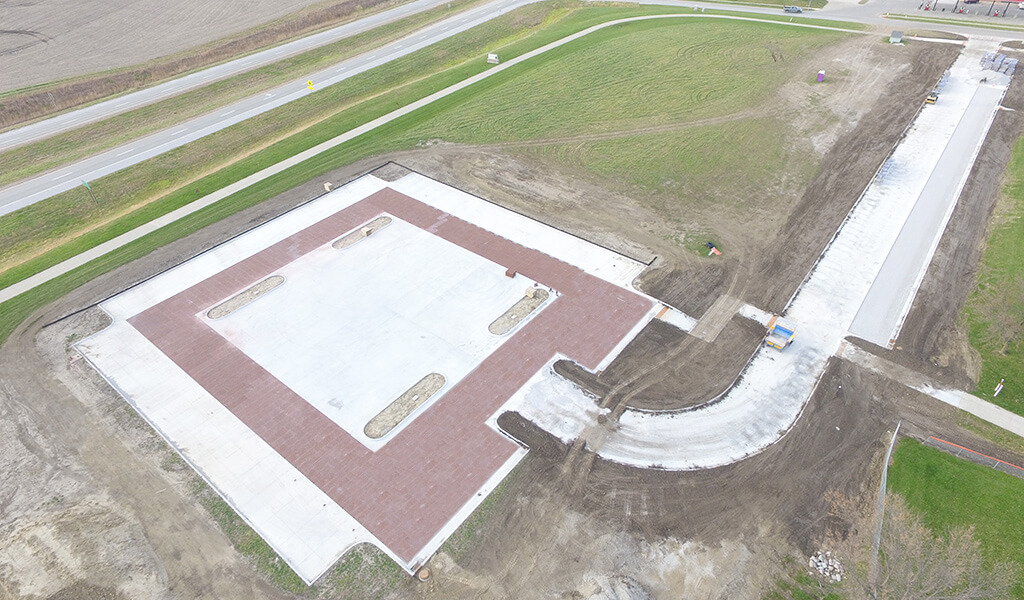
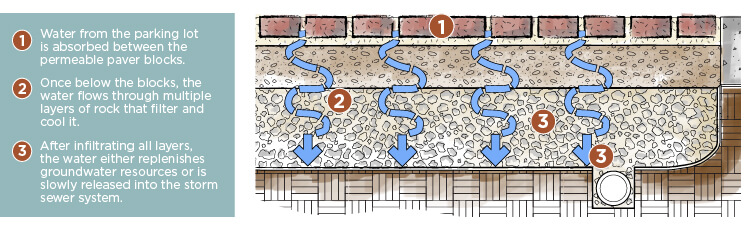
Pervious concrete, porous asphalt, and permeable pavers are types of permeable pavement. They’re underlain with stone reservoirs to store surface runoff during high-intensity storm events. The water is later infiltrated into the subsoil. Pervious concrete is a mix of course aggregate, cement, and water that supports infiltration. Permeable pavers consist of modular paver units that have void spaces resting on top of a gravel subgrade. All practices are susceptible to clogging, so sediment removal pretreatment will be required in high sediment load areas. Permeable pavers will replace impermeable, packed gravel lots in Shadle Park. Approximately 71,000 square feet of permeable surface will achieve the project goals by increasing infiltration and reducing runoff. Additional parking for visitors will also be created. High visibility of the location will help promote stormwater management practices for future urban development.
Forebay Rehabilitation
Sediment forebays are a settling basin for discharge. They allow sediment to settle from incoming water runoff before it enters a water quality BMP. Due to the USACE’s concern for sedimentation in the Red Rock Reservoir, we felt it was important to recommend a practice that would reduce sediment leaving Pleasantville. Forebay rehabilitation on Shadle Park Creek will help accomplish this goal.
Soil Quality Restoration
Soil quality restoration involves de-compacting the soil and adding compost to increase its organic matter content. On existing lawns, deep tined aeration is performed to create holes that allow water to seep six to eight inches into the top of the soil profile. Next, a shallow layer of compost is spread on top to increase the organic matter content.
Funding Secured for Water Quality Improvements
Snyder & Associates submitted a funding application to the SRF for the Clean Water SRF sponsored project program. CWSRF is a loan program specifically for the construction of wastewater improvement programs. This was ideal because it would allow the City to recoup interest on a loan previously taken out for their wastewater treatment plant and use the money for water quality improvements. Therefore, it would allow the City to complete two projects for the cost of one. The funding application was a success and resulted in the City receiving $416,000 in funds. In addition to funding assistance, topographic survey, and environmental studies and analysis, services provided by Snyder & Associates included:
- ADA compliance review and analysis
- Construction administration, observation, and staking
- Environmental permitting
- Park design and planning
- Public engagement and meeting facilitation
- Rural and urban stormwater management planning
- Site design
- Stormwater utility studies
- Threatened and endangered species studies